
C2V December Notes From The Trenches

Welcome friends! A very happy holidays to you and your families, and many thanks to each of you for another year of loyal readership. We can’t tell you how much that means to us, particularly as (if the hyperbolists are to be believed) every newsletter could be our last before we’re replaced by AI.
Just kidding, we’re not going anywhere. Even if we could be replaced, why would anyone waste the resources doing it? That would be like punting on teaching AI models to do math in favor of making deep fakes of Stephen Hawking skateboarding. Surely those harnessing this new power are better than that. Sigh.
But the pitfalls of putting amoral, spoiled children in charge of… well, just about everything, is a problem for future newsletters because (as our long-time readers know) December is prediction time!
As always, before we dust off the crystal ball, let’s look back at how we did last year.
2025 Prognostications Review
Tough year for crystal ball at C2V HQ, as only went 5-4 on our 9 tech-specific predictions, and fell right on our faces with the bonus (non-tech) prediction.
Let’s take a look at each in order (these are all truncated to save space; you can find the full version here):
The electrification of everything (everywhere but the US)
Big win out of the gate. Asia’s dominance in production of EVs continues to grow, with China alone accounting for 70% of global EV production and exports more than doubling in just the past 2 years. Meanwhile, US sales and production will likely be flat or down in 2025, even as global demand for EVs continues to skyrocket, now at 25% of global auto sales.
The money coming into GenAI will mirror the money that went into the dot com economy in the late 90’s
Easy win here. Though “absolutely dwarf”, rather than “mirror”, might have been a better description of 2025’s AI spend (more on that in our predictions below).
Listenership/viewership is going to shift to podcasts and influencer media at an even faster pace
Another easy win here. Honestly, we could probably just run this one back every year for the next several (at least) and be correct. The weekly reach of podcasts among 18 - 34 year-olds now exceeds that of television. Just let that sink in for a minute.
4. Expect a major reduction in the workforce of engineers (driven by AI coding assistant efficiencies)
Our first (big) miss here and frankly, we should have known better. While nearly every corporate R&D department is now employing AI coding assistant software and these are indeed providing big efficiency boosts (3 - 5x seems to be the consensus among our companies), companies aren’t employing fewer engineers, they’re producing more software.
Expect this to continue moving forward as both enterprise demand and platform sophistication continues to grow.
The success of AI in 2025 and beyond hinges on balancing innovation with responsibility
Another miss here, at least in terms of 2025. We still believe this to be true, but if history is any guide, guard rails won’t be seriously considered until we’ve had a whole bunch of horrific car crashes. In other words, don’t hold your breath (but definitely keep your head on a swivel).
For the first time, Nvidia will see a material decline in market share for AI chips (due to 3rd party competition and in-house manufacturing).
Given Nvidia’s 90% GPU market share in 2024, this seemed like a layup. After all, how much higher could they realistically go? Apparently to 92%. Consider our hats tipped.
The hype around Google’s new quantum computing chip has its 15 minutes, then disappears from public discourse
Given the 21st century attention-span, this was almost too easy. 15 minutes might even have been generous, as the internet almost immediately gave a collective shrug and went back to meming and complaining about stuff. For it’s worth, Google, we thought it was incredibly cool (even a hair more than those 90s-rap-AI’d-into-yacht-rock videos).
The revenge of the emerging manager (in terms of VC funding share)
Correct! This feels like a minor miracle given how the last few years have gone, as well as the historic concentration of capital in a handful of BigAI companies, but sure enough, new EM funds took in 29% of 2025 VC funding (through 3 quarters) versus 21.1% last year. We’re still well behind the 2015-19 average (38%), but hey, baby steps.
Early-stage companies see raise sizes remain flat or decrease slightly (as a result of the above rotation)
Well, the logic was sound, but we were still wrong. In fact, average “Seed” round sizes increased 46%, as multi-stage funds (perhaps realizing the mathematical corner they’ve painted themselves into?) started to dip even earlier. That said, we put “Seed” in quotes because, well, you can call a round whatever you want, even if it’s north of a $25 million raise (as 28% of “Seed” rounds have been in 2025)
Bonus Prediction: The Lions and Bills will meet again in the Super Bowl
Considering both franchises are built on soul-crushing postseason losses, this was clearly just wishful thinking
Now for the main event!
2026 Predictions
AI-native software navigation takes over: By year-end, most B2B SaaS platforms will have embedded Gen AI tools as part of their dashboards, natural language prompts will quickly become the default navigation tool, and many will see them replace traditional menus and search functions entirely.
By year end, robots will be performing enough “main street” tasks that the average urban dweller will encounter at least one per week in the ordinary course of their day. Autonomous robotics development for dozens of high-leverage use cases, taking place largely behind the scenes for years now, finally hits a sophistication inflection point allowing for scaled deployments across a number of sectors and applications. People will begin seeing these products performing regular tasks in retail, restaurants, universities, hospitals, office buildings, construction sites, and elsewhere.
Big agentic “every solution for every customer” AI companies will see accelerating churn as enterprise customers grow frustrated with the amount of in-house customization required, and the time and cost of implementation and employee training.
This is not to say that AI adoption will slow, rather that enterprise customers will rotate into products that sit within a traditional SaaS framework, purpose-built for their sectors and use cases – i.e., those that come off the shelf capable of solving their companies’ most pressing problems, pre-trained on their industries’ data, with simple and intuitive UIs designed for non-technical personnel to quickly grasp and easily incorporate into their daily workflows.
Companies across the spectrum, from Fortune 500 to 5-person law firms, will begin one of the largest restructurings in corporate history, as they adapt to new AI-powered automation. As AI rapidly replaces rote functions now performed by low-skill and entry-level white collar workers (data entry, scripted/call-center customer service, generic form/document creation, etc.), corporations across all sectors and sizes will have two key problems to address on the fly: 1) How best to retask and/or retrain these workers to work with and maximize the effectiveness of new AI tools and 2) How to replace the training that entry level workers in sectors like law and finance currently get from performing these rote tasks (e.g., how do you teach first-year legal associates to draft documents when you don’t need them to draft any of your documents?).
A new breed of cybersecurity company will emerge and rapidly scale in response to a massive increase in the volume and sophistication of spam, phishing, deep-fake, and other predatory AI bots. This should hopefully be self-explanatory, but we would just add, 1) If you think the central plot point of Mountainhead was far-fetched, well, we respectfully (and fearfully) disagree, 2) Don’t think twice, think 10 times before you click on any emailed link. We’re way (way) past the days of Nigerian princes offering commissions for moving their money, 3) Royalty-free product/company name idea for you founders: “Bot or Not” (no one under 40 will get the joke but trust us, this will crush with the average middle-aged corporate decision-maker).
Social media influencers will resign in large numbers as AI-created content takes over and replaces them. AI doesn’t do true creativity (or really anything close to it), but it’s great at repackaging generic media into other generic media, and it is considerably less expensive than most of these folks.
Anthropic will not IPO in 2026. On the one hand, Anthropic appears (from a 20,000-foot level, anyway) to have a far more sound/sustainable business model than its LLM peers (high-quality enterprise revenue, real growth, and some light at the end of the burn tunnel). On the other hand, it would be crazy to think public markets will readily embrace its current $350 billion valuation (let alone one that generates a real return for those who participated in that $350B round). But even if it did, why would they subject themselves to the administrative burden and intense quarterly scrutiny of public markets when they can continue to essentially pick any raise and valuation numbers they want and watch the BigTech/BigVC crowd trip over themselves to fill the round with no questions asked?
OpenAI will raise at least one down-round and have to drastically pare down spending and product expansion plans.
A) The current $500 billion valuation is already 6x the largest ever startup exit (before baking in even a modest 3 - 5x return to VC backers). Will someone eventually top Facebook’s now 13 year-old startup IPO record? Of course. Will it be by 25x? Absolutely, unequivocally, no.
B) OpenAI’s revenue size is impressive, but the quality isn’t (60 - 70% small consumer subscriptions), the company was already forecasting 2026 - 2029 total burn of $115B before announcing an additional $1.4 trillion in hardware spending commitments, and that burn forecast is based on truly fantastical revenue projections (for context, their projected 2030 revenue is almost double the entirety of 2024 US business software spend).
To be clear, though, they still have a great product with a lot of promise, they just need to start running the company like a real business instead of a science fiction fantasy (and pick a lane or two to dominate, rather than throwing billions at every idea that pops into someone’s head), so a harsh reality check will be a good thing for the company, long-term.
We will hit new public market highs in the first half of the year. Bubbles don’t pop when everyone is talking about bubbles popping, they pop when everyone throws in the towel on predicting a top and goes into full FOMO buying mode. Plus, markets like it when interest rates are in a downward cycle and the most recent Fed “dot plot” indicates another 50 - 100 basis points of cuts in 2026.
The bubble will burst in the second half of the year and take down the economy with it. Direct AI spending alone has accounted for 70% or so of GDP growth this year, and that doesn’t account for all of the secondary spending by those reaping the benefits of this boom.
How bad a recession we end up in is anyone’s guess, though:
On the one hand, this boom is being financed mainly by cash-rich public tech companies (who can easily absorb any losses), and private equity and private debt funds. So, banks have minimal direct exposure and the average American has essentially none.
On the other hand, 50% of consumer spending (the other pillar of GDP growth) comes from the 10% of Americans who are going to take this AI crash full in the face. So… fingers crossed?
Bonus (Non-Tech) Prediction
The US will make the semifinals of the World Cup for the first time (we’re not counting the inaugural WC in 1930 when there were only 13 teams and the semis were the 2nd round).
World Cup hosts pretty much always outperform, including the 1994 US team, which was made up entirely of college players (MLS didn’t start play until 1996) who not only inconceivably made the Round of 16, but barely lost (1-0) to eventual champs, Brazil.
For you younger readers, it’s hard to explain just how shocking this was at the time. In 1994, not only did we not have a professional soccer league or any professional soccer players, you couldn’t even find soccer on TV (from anywhere). It wasn’t just a relatively unpopular sport in the US, it basically didn’t exist.
Well, now, we have a thriving domestic league, incredibly high-level play in all manner of development leagues and academies, and a national team full of regulars on top European clubs.
Is this still a reach? For sure. Completely crazy? No.
Make us pround, fellas.



Chris spent a great couple of days in Fargo, North Dakota, and yes, it was cold, but the energy more than made up for it.
Fargo has that rare mix of quaint college-town vibe and North Midwest grit.
Friendly people, quietly ambitious builders, and some of the most “dirty and dangerous” category-defining companies are headquartered right there.
Huge thanks to the Generator team, Joe Kirgues, Troy Vosseller, and Ben Stanley — for bringing together such an impressive group to showcase their recent investments.

One highlight: Pavewise, based right in North Dakota, where C2 Ventures proudly led the seed round. Exciting to see their momentum up close.
He appreciated meeting so many founders, operators, and community leaders pushing innovation in the Midwest.

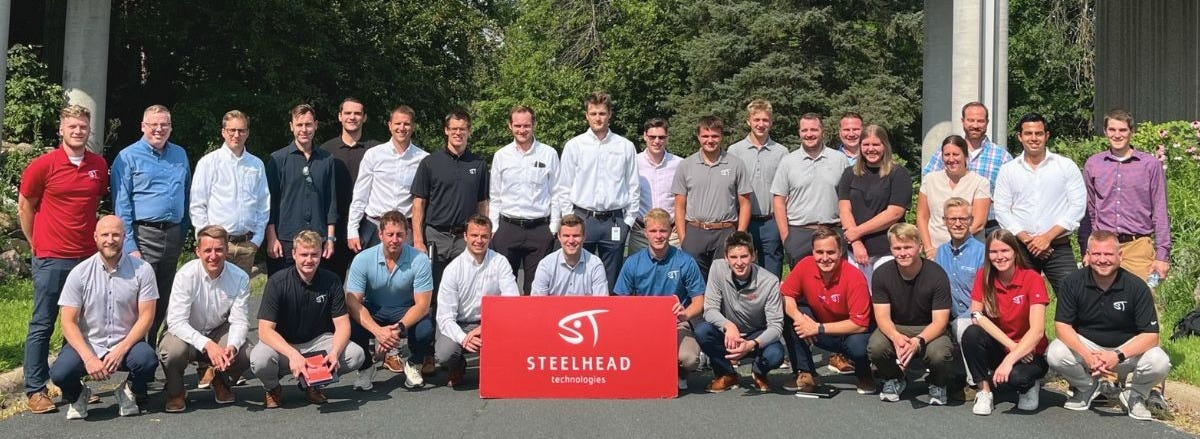
Steelhead Technologies Secures $84M Growth Investment
Huge congratulations to the Steelhead Technologies team on their $84M growth investment from Mainsail Partners.
Jeff Halonen and the team have deep industry expertise, real customer impact, and technology that actually makes hard, messy work easier for the people doing it.
Metal finishing and fabrication aren’t glamorous industries, but they’re essential. And modernizing them takes a founder who understands the problem firsthand and has the conviction to build through the complexity. That’s exactly what Steelhead has done.
C2 Ventures is excited to continue to be part of their growth as early and follow-on investors.
Read more.

Top Robotics Stocks to Add to Your Portfolio for Impressive Returns
The updated September 24, 2025 article highlights a breakout period for U.S. robotics, with Q3–Q4 2025 marked by accelerating deployments across manufacturing, healthcare, defense, elder care, and collaborative robotics. Strong order growth, major AI-driven product launches, and expanded government and enterprise investment are pushing robotics toward mainstream adoption, supported by advances in physical AI, 5G, and autonomous systems. Trimble, NVIDIA, and Teradyne are positioned as key beneficiaries—Trimble through AI-powered construction automation, NVIDIA as the core infrastructure layer for physical AI and robotics, and Teradyne via collaborative and mobile robots—collectively illustrating why robotics is emerging as a multi-decade, cross-industry growth theme heading into 2026.
Pioneers and Pathfinders
Ross Guberman, founder and CEO of BriefCatch, a leading legal writing assistant that helps lawyers communicate with clarity and precision, joined the Pioneers and Pathfinder podcast. A former BigLaw attorney and award-winning journalist, Ross draws on decades of experience teaching opinion and advocacy writing to top law firms, judges, agencies, and corporations around the world.
In the conversation, Ross shares his path into law, the analytical framework he developed for evaluating great legal writing, and key lessons from building BriefCatch into a category-defining product. The episode also explores how technology—and generative AI in particular—is reshaping legal writing, and what these changes could mean for the future of the legal profession.

Impilo Expands Digital Health Offerings Through Partnership with Eko Health, Featuring the Eko CORE 500™ Digital Stethoscope
Impilo announced a strategic partnership between its e-commerce platform, The Digital Health Store, and Eko Health to make the Eko CORE 500™ Digital Stethoscope available directly within Impilo’s ecosystem. The collaboration expands access to AI-powered cardiac and pulmonary diagnostics for clinicians, supporting both in-person and virtual care. By integrating Eko’s advanced diagnostic technology into its hybrid healthcare platform, Impilo continues its mission to bridge innovative digital health tools with practical, scalable clinical care.
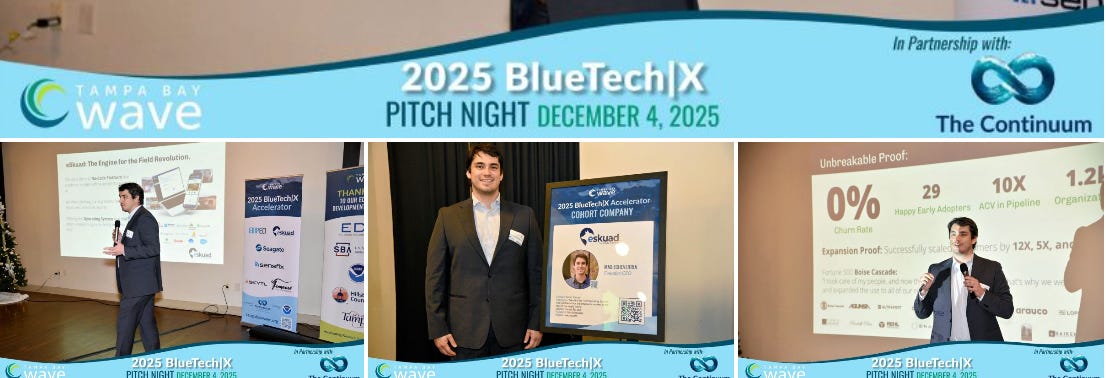
BlueTechX Accelerator
Huge congrats to the eSkuad team on pitching in person for the first time at BlueTechX in Tampa.
After nearly three months in the BlueTechX Accelerator—run by Tampa Bay Wave and The Continuum with support from NOAA—the team wrapped up an incredible stretch of learning, connection, and growth.
Love seeing founders build in community, turn classmates into partners, and sharpen their story in front of a live audience.
AI Bottleneck: Electricians, not Inference, Chips or Power
Most people talk about chips and GPUs. Ian Hoppe argues the real AI bottleneck hides in 5.9 million undocumented commercial buildings and the trillions of wires behind their walls.
Ian is a master electrician and the founder & CEO of Condoit. He explains how undocumented systems inside hospitals, data centers, and factories raise the risk of fires, outages, and lost lives. He shares why a single data center outage often burns around $500,000 dollars per hour and why, without Condoit, no one knows what feeds the chiller keeping the racks cool until crews go and trace wires by hand.

Retrievables is Helping Businesses get Paid, Without the Drama
Jeremy Crane, founder and CEO of Retrievables, is modernizing an industry few people dream of entering: debt collection. What started as domain expertise gained at a New York collections law firm turned into a venture-backed platform that helps businesses recover delinquent payments without outdated tactics. Retrievables operates as a tech-enabled marketplace, instantly matching companies with the right collection agencies or law firms, helping businesses get paid faster while creating new demand for service providers.