
C2V June Notes From The Trenches

Welcome friends! We’ve had a couple of recent, somewhat under-the-radar tech/venture/startup developments in the queue for a bit and figured it was time to discuss them both. Both are a bit technical and in the weeds, but bear with us, as each has potentially large and wide-reaching implications.
(Look, we’d rather be talking about the World Cup too, but duty calls).
Data Center Capacity Growth – Issues & Implications
As truly staggering and unprecented as the level of investment in AI computing infrastrucure has been, there are nonetheless increasingly severe bottlenecks hampering the planned rollout of new data center capacity -- reportedly half of all planned 2026 and 2027 US builds are now delayed or canceled outright with 75 ($130 billion worth) delayed or cancelled in the first quarter alone.
We think both the real bottleneck (not what you’d think) and implications are worth a quick look.
Under-the-Radar Roadblock
Remember when one-point-twenty-one gigawatts of electricity made Christopher Lloyd crash out in his Hill Valley garage? This year alone, five AI data centers are expected to come online that each have at least this much capacity (with total global capacity already in excess of 100x this), prompting a frenzied dialogue around how to increase power generation capacity, with ideas ranging from big investments in natural gas pipeline infrastructure to micro nuclear facilities (though we’re still waiting for that first “lightning power” startup deck -- Clock Tower Energy maybe?).
With numbers on this scale, it’s not surprising that power consumption needs, along with the persistent shortage of GPUs, have dominated the data center capacity conversation of late. Indeed, power and GPU supplies are legitimate, material constraints that are undeniably difficult issues to solve, given their logistical and technical complexity.
But the biggest of all the bottlenecks is the one that seems to be getting almost no attention at all -- the deeply unglamorous and relatively uncomplicated business of getting electricity to the rack. With severe shortages and production lead times now 2.5 to 5 years, it is in fact the limited supplies of that technological marvel of the 1880s – the power transformer – that is proving to be the biggest obstacle to AI processing capacity (dare we say, the dirtiest, dullest, and most dangerous aspect of these businesses being the most critical, highest leverage component).
As crazy as it may seem that these simple steel boxes that step voltage up and down and account for less than 10% of a data center’s cost could be this much of an impediment, the world’s first modular fusion reactor and an unlimited supply of GPUs will do you no good if you don’t have enough of the 150+ year-old electrical transmission tech needed to connect the two (maybe the big Bay Area VCs should have been hoarding transformers instead of GPUs).
Of course, just like the power and GPU production capacity issues, electrical component production shortages are a solvable issue, the problem is they need to be solved right now and that’s just not possible, no matter how much money BigAI might throw at the problem (and they’re certainly trying). So how does this problem get solved, and what are the implications of the potential solutions?
The Implications
As noted above, any investment that could break the basic transmission infrastructure log jam (and the looming power generation capacity one) in the immediate term needed to start three years ago. So, if AI developers have to reset compute capacity expectations, where does that leave us?
More broadly speaking, the optimistic case seems to be that maturing models are leading to an increase in inference (a lower power user) as a share of compute – Deloitte projects inference will be two-thirds of all AI compute in 2026, up from half last year – and the coralary that smaller, more specialized models are now sophisticated enough that they can match the big foundation models’ performance on more narrow knowledge bases and use cases at a fraction of the energy usage.
This latter trend rings true our portfolio companies (all of which operate similar smaller, more targeted use-case models), where we are seeing that as models get smarter within their industry- and task-specific applications, token use does decline meaningfully.
There are also some pointing to more applications with narrower use cases shifting from cloud to edge, which is expected to further lower overall compute usage.
One fun wrinkle from this camp – we might have a new buzzword metric (buzzmetric?) in “tokens per watt”, that everyone will now say and almost no one will actually pay any attention to. Look for it at a Bay Area coffee shop near you.
The pessimists counter seems to primarily be that reasoning models change the picture entirely. Deloitte, as one, predicts that “long thinking” at inference, which they say can burn more than 100x the compute of a simple query, will swallow these efficiency gains whole.
Even if the optimists are directionally right, it remains to be seen if these efficiency gains are enough to account for whatever slowing in compute capacity we may see. The current consensus view on LLMs seems to be that we can already write-in today’s frontrunners as the long-term winners, but we have previously posited that we wouldn’t be surprised if an entirely new, and far more efficient, training methodology comes out of left field and upends the current leaderboard entirely (similar to how Google upended search 25 years ago), and a significant slowdown in capacity build could be the impetus for this.
It’s also not entirely out of the realm of possibility that one of the big LLMs has to shut down or pivot to more of a compute capacity lessor (is xAI already stealth doing this? How this plays out remains to be seen, but it seems that we should expect to see the status quo disrupted; it’s just a question of to what degree.
Acquihire as an Aspirational Exit Strategy?
In July 2025, Google paid roughly $2.4 billion for Windsurf, the AI-coding startup. Except it didn’t. Google didn’t buy Windsurf at all. It licensed Windsurf’s technology on a non-exclusive basis and hired the CEO, a co-founder, and about 40 key researchers into DeepMind — no stock purchased, no company acquired, and significantly different economics than with a regular acquisition.
In this case, Google paid roughly $1.2 billion to investors and $1.2 billion in comp for the 40 employees it decided to bring over (a healthy chunk of it to the founders)… and $0 to the other ~200 employees, who not only didn’t get hired, they also got nothing for their equity which remained in a now-hollowed-out shell company
It’s hard to know how this allocation of cash compares to what a traditional cap table waterfall would have produced for the various stakeholders, but it seems highly likely that Windsurf’s founders and handful of retained employees made far more than they ordinarily would have. This certainly came at the expense of their employees, and likely their VCs as well given how much money they raised and where you would expect that to leave the founders’ ownership stake. That said, the VCs presumably at least signed off on the “sale” (in a typical governance structure, they would’ve had to for the deal to close), but the employees were robbed, plain and simple, and the founders were rightly torched by Vinod Khosla and others for leaving those employees in the wind.
More troubling is that this wasn’t a one-off, it’s a structure that’s been repeated several times over the past two years:
Microsoft–Inflection (March 2024): ~$650M to license the models and hire Mustafa Suleyman plus ~70 staff. Investors had put in $1.3 billion; they got back roughly $1.10 – $1.50 on the dollar.
Amazon–Adept (June 2024): founders to Amazon’s AGI team, non-exclusive license; the investors who had funded $414 million were made roughly whole.
Amazon–Covariant (August 2024): founders and about a quarter of the staff to Amazon, models licensed.
Google–Character.AI (August 2024): Noam Shazeer and team back to Google, a roughly $2.7 billion license.
By one count, Google, Microsoft, Amazon, and Meta have spent north of $20 billion since early 2024 acquiring the founding teams of AI startups without technically acquiring a single one.
Early stage VCs are certainly familiar with acquihires, but as a soft landing for a company that was out of money and would otherwise have died, not as a successful, late-stage exit strategy. Billion-dollar-plus exits are supposed to be the exits that produced most or substantially all of fund’s returns (returns that should be outstanding at these dollar levels). Making your money back on an exit of this size is almost worse than having that company fail early on (especially for those VCs who participated in multiple follow-on rounds).
It’s also worth noting that not all VCs on a cap table are created equal and these acquihire structures are massively tilted to the detriment of early-stage investors. While a 1.5x return on a multi-billion-dollar exit might not be all that bad – and perhaps even a bailout – for Series D/E/F participants, it is a complete sandbagging for early-stage investors.
We’ve written previously about how many recent billion-dollar-plus IPOs saw late-stage investors barely make their money back (or even lose money), but the early-stage investors in these companies, as you would expect, saw entire funds’ (if not entire careers’) worth of returns generated by each one of these exits. With these acquihire structures, all investors are treated the same, whether they made smart, early, deep value bets years earlier, or piled money into expensive late rounds six months before the exit. Incidentally, it’s these same late and large investors who would generally be the ones contolling the investor votes needed to bless these deals. Just saying.
We mentioned above that the Windsurf deal wasn’t a one-off, but these types of quasi-exits are still somewhat rare, so hopefully it doesn’t become more of a trend. But if there are many more of these, we may very well see the standard funding documents start explicitly treating full senior-team lift-outs as liquidity events, subject to the standard cap table waterfall. Until then, early-stage managers, heads on swivels.




What the Secondaries Market Is Signaling
Chris shares why the secondaries market may be one of the clearest early signals that venture liquidity is beginning to improve.
IPO activity is picking up, M&A appears to be thawing, and strategic buyers and private equity firms are showing renewed interest. But many of the most revealing transactions are happening quietly, as new buyers approach early investors to purchase private company positions ahead of a larger liquidity event.
C2 Ventures has seen multiple secondary opportunities that could have returned meaningful portions of fund capital from its initial investments. In several cases, the firm chose to hold because it remains confident in the founders and the companies they are building.
These transactions rarely make headlines, but they suggest that buyers are becoming more active and that the gap between private and public market expectations may be narrowing. Chris sees the combination of stronger secondary activity, reopening IPO markets, and potential movement in M&A and private equity as the beginning of a healthier liquidity environment.
Why Founders Should Be Wary of Absolute Market Narratives
Chris shares why the venture industry’s tendency toward dramatic swings can create more noise than useful guidance.
First came the declaration that SaaS was dead. Now, the rapid rise of AI has prompted claims that founders no longer need venture capital. In reality, both arguments overlook how differently companies, markets, and founders operate.
AI is lowering the cost of building, testing, and moving quickly, giving founders more leverage than ever. But decisions about raising capital still depend on the company’s stage, customer adoption, market dynamics, sales cycle, distribution, retention, and ability to expand.
Chris’s advice to founders is to pay attention to how the market is changing without allowing headlines to undermine confidence in what they are building. AI will reshape many parts of the startup ecosystem, but great companies will continue to be built—and financed—case by case.


Pavewise Partners with Lehman-Roberts to Modernize Asphalt Operations
Pavewise has announced a new partnership with Lehman-Roberts Company, a longstanding leader in infrastructure construction known for its commitment to quality, safety, and innovation.
The partnership will bring connected field data, streamlined quality control, and real-time paving performance analytics into Lehman-Roberts’ operations, helping teams collect, manage, and use project data more effectively. Working alongside Cory Collins and the company’s quality control and operations teams, Pavewise is continuing to advance a more connected, data-driven future for asphalt construction.
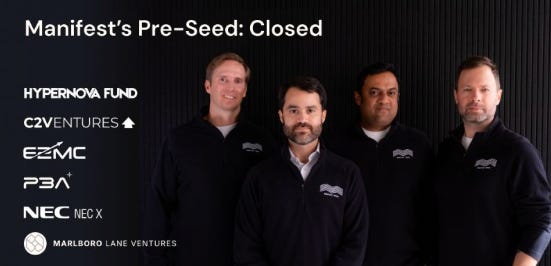
C2 Ventures Makes Its First Space Investment in Manifest Space
C2 Ventures has joined Manifest Space’s oversubscribed $1.15 million Pre-Seed round, marking the firm’s first investment in the space sector through the Tributary II fund.
Manifest Space is building onboard traffic-awareness technology that helps operators identify, locate, and monitor satellites during the most uncertain stages of a mission. Its first product is an independent optical beacon that broadcasts a spacecraft’s identity, position, and status without relying on its primary communications systems, GPS availability, or upgrades to existing ground infrastructure.
The company plans to demonstrate the technology aboard SpaceX’s Transporter-18 mission, currently scheduled for no earlier than October 2026. The new funding will support the beacon and a compact transponder platform through critical design review, flight validation, qualification, and production.
As more satellites enter increasingly crowded orbits, Manifest is building the persistent identity and coordination infrastructure needed to make space operations safer, more visible, and more reliable.

BriefCatch Brings Context-Aware Guidance to Legal Writing
In a new video, BriefCatch founder Ross Guberman demonstrates how the platform tailors its recommendations to the specific writing task, helping lawyers strengthen clarity, persuasion, and precision.
By providing more context-aware feedback, BriefCatch helps law firms improve writing quality and scale stronger legal communication across their teams.
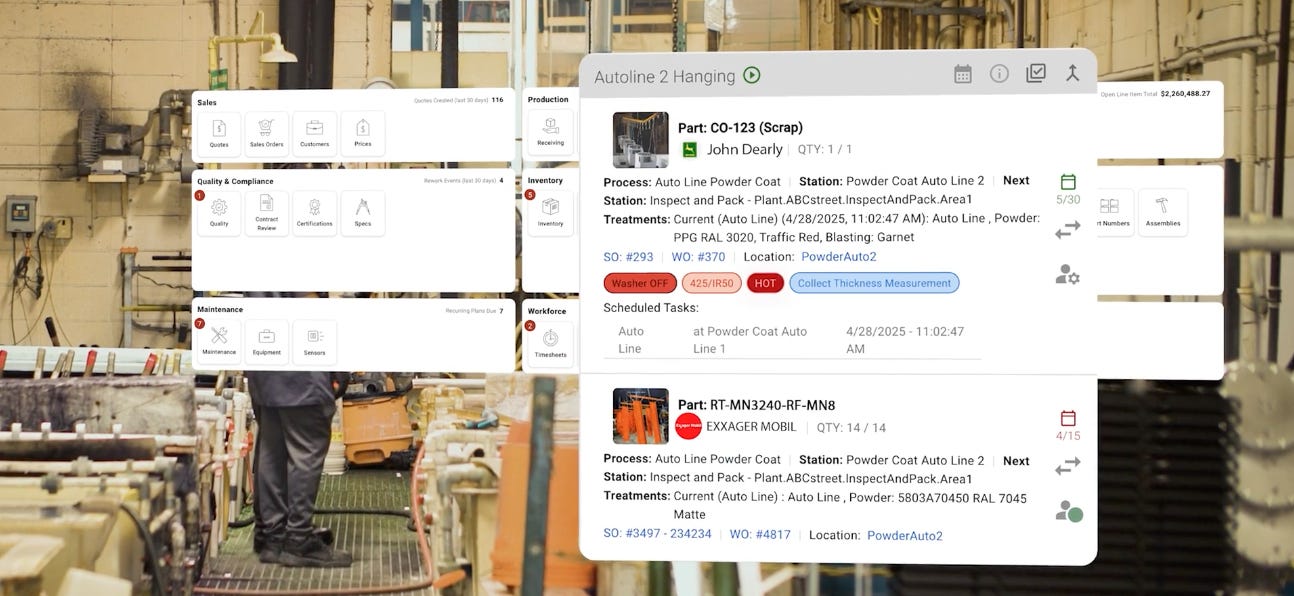
Steelhead Marks Five Years of Growth Across the Job Shop Industry
Steelhead is celebrating its fifth anniversary with more than 300 job shops using its platform, and over two billion parts have been moved through the system.
Customers growing with Steelhead now average more than $180,000 in annual revenue per employee, reflecting stronger margins, faster throughput, and more efficient operations. What began as a mission to replace spreadsheets and disconnected workarounds with software built specifically for job shops has grown into a team of 110 employees serving manufacturers across the country.
As Steelhead enters its sixth year, the company is preparing to introduce new AI capabilities designed to further transform how shops operate.

Noteworthy AI Selected for Vermont Grid-Resilience Pilot
Noteworthy AI has been selected for one of four new pilot projects funded through the DeltaClimeVT energy business accelerator, which awarded a combined $110,000 to test technologies supporting Vermont’s clean energy transition.
Working with the Vermont Public Power Supply Authority and Northfield Electric Department, Noteworthy AI will deploy its vehicle-mounted cameras and AI technology across utility systems in Northfield and Burlington. The pilot will evaluate how effectively the platform can identify vegetation risks and automate the collection of utility asset data.
The project will provide real-world performance data as participating utilities assess the technology’s potential to strengthen grid reliability, improve resilience, and increase operational efficiency. If successful, the pilot could create a pathway for broader adoption across Vermont’s utility network.
eFlexFuel Expands Flex-Fuel Access While Reaching Major Emissions Milestone
A new video highlights California legislation that could expand access to federally approved E85 conversion kits, potentially opening a significant new market for eFlexFuel and giving more drivers the ability to use E85, gasoline, or a combination of the two.
The update comes as eFlexFuel reports a major sustainability milestone: its customers have collectively avoided 560,000 tonnes of CO₂ emissions and driven 4.65 billion kilometers using the company’s solution since launch. In 2026 alone, customers avoided 41,000 tonnes of CO₂ across 342 million kilometers driven.
That all-time distance is equivalent to approximately 116,000 trips around the Earth, while the avoided emissions are comparable to roughly 120,000 return flights between Helsinki and New York or the annual carbon absorption of more than 25 million trees.
Together, the policy momentum and customer impact demonstrate the potential for flex-fuel technology to give more drivers practical access to lower-emission transportation.
Pavewise Partners with Clyde Companies to Advance Digital Paving Operations
Pavewise has announced a strategic partnership with Clyde Companies, including Geneva Rock and Suncore, to modernize how asphalt paving teams collect, manage, and use field data.
By combining Pavewise’s digital paving platform with Clyde Companies’ industry expertise and operational scale, the partnership will focus on standardizing data collection, strengthening quality control, and delivering more actionable insights from the field to the office.
The collaboration will also create opportunities to develop, validate, and scale practical digital tools that improve consistency, visibility, and efficiency across paving operations. Special recognition goes to Daniel McDaniel and the Geneva Rock team for championing the future of digital quality control and paving performance analytics.

GoodRoads Explains How Cities Can Triage Underfunded Road Networks
In a new guide, GoodRoads founder Chris Sunde outlines how cities can make better pavement decisions when their available budget covers only a fraction of what the road network needs.
Rather than directing funds toward the worst roads first, the framework prioritizes projects where each dollar can protect the most long-term value. That means preserving good roads before they deteriorate, making deliberate decisions about roads approaching the rehabilitation threshold, and using traffic volume to prioritize between roads that remain viable candidates for treatment.
The guide also emphasizes coordinating paving plans with upcoming utility and drainage work and limiting spending on failed roads to essential safety maintenance until capital reconstruction funding is available.
By sorting roads into clear treatment categories, local governments can avoid exhausting maintenance budgets on assets that are already too far gone while protecting more of the network from reaching that point.
Civ Robotics CEO Discusses the Future of Construction Automation
Civ Robotics Co-Founder and CEO Tom Yeshurun joined the Behind the Robot podcast to share how a $4 million surveying challenge inspired the company’s autonomous construction technology.
The conversation covers Civ Robotics’ founding story, the pivot that reshaped the business, and the lessons learned while scaling a robotics company through the pandemic. Tom also discusses how persistent labor shortages are accelerating the adoption of AI and automation across construction and renewable energy projects.
With more than 10 million coordinates marked and deployments across the United States, Europe, Australia, and the Middle East, Civ Robotics is helping infrastructure teams complete surveying and layout work faster while filling critical gaps in the construction workforce.

Alivo is Hiring!
We’re actively recruiting for multiple positions at Alivo. Visit our careers page to learn more. We’d especially appreciate introductions to any candidates for our top-priority roles:
Senior Engineer: We’re hiring a Senior Engineer to build and ship product features, leverage cutting-edge AI technologies, and help scale the foundation of Alivo.
Manual QA Engineer: We’re looking for a Manual QA Engineer to ensure every release meets a high bar for quality while helping create reliable, natural, and effective AI customer experiences.
Talent Acquisition & People Operations Manager: We’re seeking a Talent Acquisition & People Operations Manager to attract exceptional talent, build scalable people processes, and support Alivo’s continued growth.